Titanium Weight vs Aluminum: An Engineer's Practical Guide
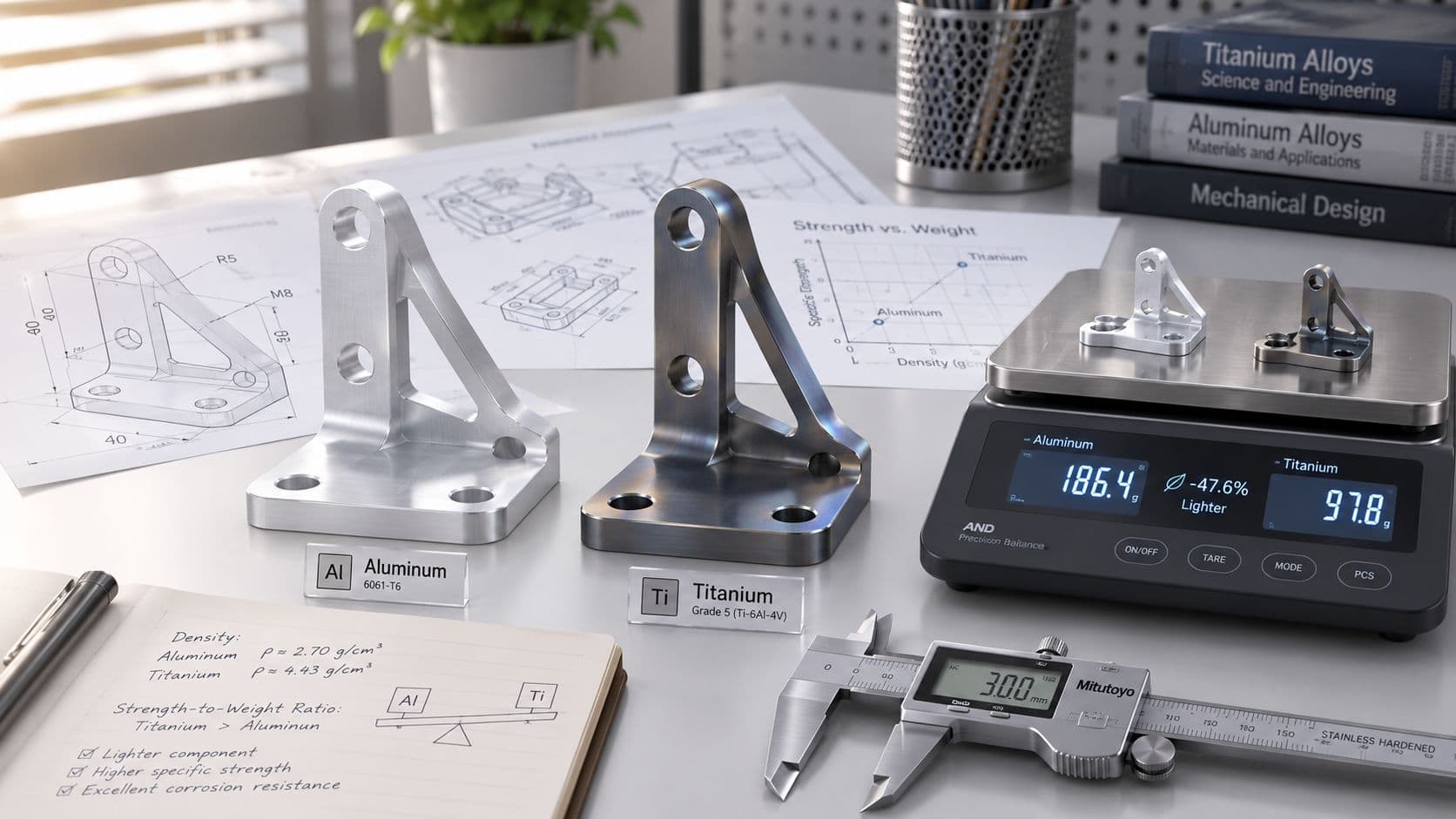
A titanium part with the same geometry as a 6061 aluminum part is usually about 60% to 67% heavier by volume, because titanium sits around 4.43 to 4.51 g/cm³ while 6061 aluminum is about 2.70 g/cm³ (Arcus CNC weight comparison). That's the number many search for, but it's not the number that decides a real program. In practice, the better question is which material gives you the lightest qualified part at the lowest iteration risk, because a lighter raw material can still lose once you factor in machining speed, tool wear, inspection burden, and the cost of redesigning a part that didn't validate on the first pass.
| Property | Ti-6Al-4V | 6061-T6 | 7075-T6 |
|---|---|---|---|
| Relative density | Heavier than aluminum by volume | Lighter baseline | Lighter baseline |
| Machinability | Difficult | Excellent | Good |
| Prototype iteration risk | Higher | Lower | Lower to moderate |
| Typical use case | High-performance, harsh duty | General structures, fast iteration | Higher-strength aluminum brackets and links |
Table of Contents
Typical Alloys Engineers Actually Specify- Where each alloy fits
Strength-to-Weight Calculations That Actually Matter- When the lighter alloy wins anyway
Cost, Machinability, and the Hidden Iteration Tax- Why titanium burns time
Corrosion Behavior and Surface Finishing Options- Finishes that belong on each metal
Manufacturing Processes, Tolerances, and Inspection- What each process really favors
Material Selection Decision Matrix for NPI and Production- A simple project-stage filter
Practical Recommendations and When to Pay the Titanium Premium
What the Titanium vs Aluminum Weight Question Really Means
The density gap is the starting point, not the verdict. Titanium is commonly placed around 4.43 to 4.51 g/cm³, while 6061 aluminum is about 2.70 g/cm³, so titanium is roughly 1.64 to 1.67 times denser by volume. Arcus CNC weight comparison For the same geometry, the titanium version usually comes out heavier, not lighter.
The Wrong Question vs. The Right One
A lot of engineering teams ask, “Which is lighter, titanium or aluminum?” That sounds precise, but it leaves out the two constraints that matter in real hardware, strength and manufacturability. The better question is whether titanium lets you thin a wall, remove a rib, or shorten a load path enough to recover the density penalty without creating a new risk in machining or inspection.
Aluminum is the lighter baseline choice when the job is to minimize mass for the same part envelope. Titanium only starts to win when the design can be reworked around its higher specific strength, usually in parts that are stiffness-limited, load-critical, or exposed to a harsh environment.
Practical rule: If the CAD stays the same, titanium gets heavier. If the CAD changes intelligently, titanium may recover the weight, but it rarely does so cheaply.
That distinction matters before the first quote comes back. Many programs do not fail on raw performance, they fail because the team selected a strong material before proving the geometry, then paid for extra cycles, extra tool changes, and extra metrology just to discover the bracket was overbuilt in the first place.
For prototype work and NPI, the target is the lightest qualified part at the lowest iteration risk. That is where the material choice turns from an abstract density comparison into a manufacturing decision. Aluminum often reaches that target faster because it is easier to machine, easier to revise, and easier to inspect. Titanium may still be the right call, but only when the design needs what titanium gives and the team can absorb the slower cut times and higher machining burden. If you want a broader selection view across common stock forms and alloys, start with material options for CNC programs.
Typical Alloys Engineers Actually Specify
Engineers don't buy “titanium” or “aluminum” in the abstract. They specify a particular alloy because the alloy decides how the part machines, how it finishes, and how much margin the design really has. The common workhorse choices are Ti-6Al-4V, 6061-T6, and 7075-T6, and they occupy very different corners of the design space.

Where each alloy fits
Ti-6Al-4V, also called Grade 5 titanium, is the default when performance dominates and the part can justify harder machining. It's widely used in aerospace and medical applications because it combines high strength with excellent corrosion resistance and biocompatibility. The trade-off is that it's not a friendly material for fast iteration.
6061-T6 is the everyday aluminum choice for structural parts, enclosures, fixtures, and welded assemblies. It's popular because it machines cleanly, accepts many finishing options, and is forgiving during prototyping. If a team wants a part that can move from CAD to hardware without drama, 6061 is often the safest first call.
7075-T6 is the stronger aluminum option when the design needs more stiffness and higher stress capability than 6061 can comfortably provide. It's a common choice for aerospace and defense brackets, robotic interfaces, and performance hardware where weight matters and the part still needs to be machined efficiently.
For a useful materials overview tied to fabrication services, the materials capability page is a practical reference point. The important takeaway is simple, Ti-6Al-4V is for critical function, 6061-T6 is for broad utility, and 7075-T6 is the high-strength aluminum compromise.
Selection cue: If your first instinct is “titanium because it's stronger,” pause and ask whether the part actually needs titanium's strength, or just better geometry and a higher-grade aluminum.
Strength-to-Weight Calculations That Actually Matter
Density by itself doesn't solve the design problem. What matters is whether the part can meet load, stiffness, and fatigue targets after the geometry changes. That's why titanium's reputation for strength-to-weight can be real in one bracket and irrelevant in the next.
When the lighter alloy wins anyway
Take a compact drone arm. If the arm is stiffness-limited, the design often needs enough section modulus to control deflection more than enough material to survive pure stress. In that case, the part's final mass is driven less by the raw density of the alloy and more by how thin the wall can safely go without turning the arm into a vibration problem.
A 200 g aerospace bracket follows the same logic. If the bracket is carrying a load but also has generous geometry, 7075-T6 often gets very close to the needed performance with less machining pain than titanium. The higher-strength aluminum lets the engineer protect the load path without paying for a slower titanium cycle.
A 150 mm robotic link usually sits somewhere between the two. If the axis is payload-sensitive, titanium can make sense, but only if the stiffness target and the joint architecture let the designer take real mass out of the section. If the geometry can't shrink, titanium just becomes a heavier, more expensive way to make the same shape.
The real engineering test
The question isn't which alloy has the best bragging rights. It's which alloy lets you hit the strength target, stiffness target, and inspection target with the least redesign risk.
- 6061-T6: Best when the part is still in geometry discovery and you need quick proof.
- 7075-T6: Best when you need more mechanical margin but still want aluminum's process speed.
- Ti-6Al-4V: Best when the design is already mature and the application needs titanium's combination of strength and durability.
The right answer often changes as the part moves from concept to qualified hardware. Early on, a team should care more about validating the load path than winning a material purity contest.
Cost, Machinability, and the Hidden Iteration Tax
Titanium's biggest penalty shows up on the machine, not in the spec sheet. For CNC prototyping, titanium machining is typically 3 to 5 times slower than aluminum, and finished-part cost runs about 3 to 8 times higher once tool wear, slower feeds, and rigid fixturing are included (RapidDirect titanium vs aluminum comparison). That's the part many quote sheets don't make obvious until the program is already committed.
Why titanium burns time
Titanium is difficult because it doesn't help the cutter much. It tends to push heat into the tool, which shortens tool life and slows feeds. The result is a machining strategy built around caution, not speed, and that caution shows up everywhere, from roughing passes to finishing passes to setup discipline.
Aluminum behaves differently. It cuts more willingly, clears chips better, and generally supports quicker trial-and-error. That's why a design change on aluminum often becomes a same-week revision, while the same change in titanium can turn into a re-fixture, fresh tooling, and another long machine cycle.
Why iteration risk matters more than material romance
Hard truth: The cheapest titanium part is the one you never needed to machine twice.
That line sounds blunt because it is. In NPI, the hidden cost isn't just part price, it's the cost of learning. If the design is still moving, aluminum usually gives the team the fastest path to a qualified part because the geometry can be edited, re-cut, inspected, and retested without turning every lesson into a major expense.
For that reason, many teams choose aluminum not only because it's lighter per volume, but because it's the faster route to a valid design. That's especially true when the first objective is a functional prototype or short-run bridge build, not the final production hero part.

Corrosion Behavior and Surface Finishing Options
Titanium and aluminum both form protective oxide layers, but they don't behave the same way after machining, finishing, or exposure to harsh service. Titanium is the cleaner choice when corrosion resistance is the priority, especially in wet or chemically aggressive environments. Aluminum can still be the right answer, but the finish stack has to be chosen deliberately.
Finishes that belong on each metal
Aluminum accepts anodizing well, including Type II cosmetic anodizing and Type III hardcoat when wear resistance matters. That makes it a strong choice for consumer housings, instrument panels, and enclosures where color control and surface consistency matter as much as mass. Bare aluminum, on the other hand, needs more caution in corrosive or outdoor use.
Titanium is typically finished with passivation, bead blasting, polishing, or PVD coatings rather than the same anodizing strategy used on aluminum. It can produce attractive surface effects, but not the same vibrant color palette that designers expect from anodized aluminum without special processing. That's a real styling constraint for visible parts.
For a deeper look at finish options tied to functional and cosmetic requirements, the surface finishing resource is worth keeping handy.
What to specify by environment
A marine bracket asks for corrosion resistance first, and titanium is the safer bet when the budget supports it. A consumer enclosure asks for appearance, repeatability, and manageable cost, which often points back to anodized aluminum. A medical housing can go either direction depending on cleaning chemistry, sterilization method, and whether the appearance has to stay stable over time.
One design caveat deserves special attention. Welded 6061 loses significant strength in the heat-affected zone unless it's re-aged, so weld strategy matters as much as base material selection. If the part is welded and the load path crosses the weld, that has to be designed in from the start.
Rule of thumb: Choose the finish for the environment first, then the alloy for the base structure, not the other way around.
Manufacturing Processes, Tolerances, and Inspection
Process choice can make a material look better or worse than it really is. A well-placed CNC program will make aluminum look effortless, while titanium will expose every weak spot in setup, tooling, and metrology. The same design can succeed or fail depending on how it's built.
What each process really favors
CNC machining is where aluminum shines. Three-axis, four-axis, and five-axis work all benefit from aluminum's forgiving chip behavior, which makes tight-tolerance prototypes routine and inspection simpler. Titanium can absolutely be machined, but the fixturing must be more rigid and the process window is narrower.
Additive manufacturing changes the trade slightly. Titanium is often a better fit for powder-bed metal printing in high-value parts because the process can justify the material cost and geometry complexity. Aluminum alloys can also be printed, but the decision usually depends on the specific build method and the part's qualification path.
Sheet metal fabrication generally favors aluminum when weight and formability matter, though the final choice depends on thickness, bracket geometry, and finish requirements. Injection molding is not a metal process, so it's only useful as a benchmark when teams compare what a plastic enclosure could do instead of a metal one. Vacuum casting falls outside metal selection entirely.
Inspection burden changes with material
Titanium parts usually demand more discipline in inspection because machining conditions are less forgiving. That often means more attention to CMM verification, scanning, and surface checks after machining. Aluminum still needs inspection, but the process is typically less stressful and the correction loop is faster.
If you're sourcing a complex machined part, the CNC machining service page is a practical place to compare process capabilities against the design intent.
The hidden truth is that tolerances aren't just a CAD callout. They're a negotiation between material behavior, machine strategy, and how many times the part can be reworked before the schedule slips.
Material Selection Decision Matrix for NPI and Production
The cleanest way to choose between titanium and aluminum is to map the material to the project stage, not just the part number. Concept prototypes reward speed. Bridge builds reward repeatability. Production rewards stable economics and supply discipline.
A simple project-stage filter
For a concept prototype, 6061-T6 is usually the first move because it supports quick geometry changes and low iteration risk. If the part is critical, titanium can still be justified, but only when the function is essential and the design is already constrained by the application.
For an NPI bridge build, aluminum usually stays in the lead because the team is still learning about fit, form, and function. If the part is being pushed toward extreme loads, 7075-T6 becomes the stronger aluminum candidate before anyone jumps to titanium.
For low-to-mid production, the answer depends on whether the cost model or the performance model dominates. Cost-driven parts stay in aluminum. High-performance niche parts can move into titanium when the program can absorb the slower cycle times and more demanding inspection flow.
Where the material fits by application
- Aerospace structural: Titanium makes sense for critical features, but aluminum still owns many weight-sensitive structures where manufacturability matters.
- Consumer electronics: Aluminum usually wins because appearance, mass, and cost all matter at once.
- Medical device: Titanium earns its place when corrosion resistance and biocompatibility are central to the design.
- Robotics and automation: Aluminum often gives the best balance of mass reduction, stiffness, and iteration speed unless payload or wear pushes the part into titanium territory.
Best filter: Choose the lightest qualified part, not the most exotic one. If aluminum qualifies the geometry, titanium is usually a premium, not an upgrade.
Practical Recommendations and When to Pay the Titanium Premium
Default to 6061-T6 for prototypes and short runs when the goal is fast validation. Move to 7075-T6 when aluminum's strength needs a boost without sacrificing too much machining speed. Pay for Ti-6Al-4V only when the design is mass-critical, stiffness-limited, or exposed to an environment where titanium's durability solves a real problem.
Aerospace structural brackets can justify titanium when performance is essential and the build is mature enough to absorb the slower cycle. Medical implants and biocompatible hardware often justify titanium for reasons that go beyond weight alone. High-end consumer products can also carry the premium when the material is part of the value proposition, not just a hidden engineering choice.
For robotics, the decision comes down to payload and motion efficiency. If shaving mass directly improves reach, speed, or load margin, titanium may earn its place. If the part is still evolving, aluminum usually gets you to a qualified answer faster.
Use this checklist in the next design review: confirm the load case, check whether stiffness or mass is driving the geometry, decide whether the finish requirements favor anodizing or titanium surface treatment, and ask whether the build is still in learning mode. If the answer points to iteration risk, start with aluminum. If the answer points to a mature, high-value function that can't tolerate compromise, titanium is worth the premium.
A CTA for LC Proto.