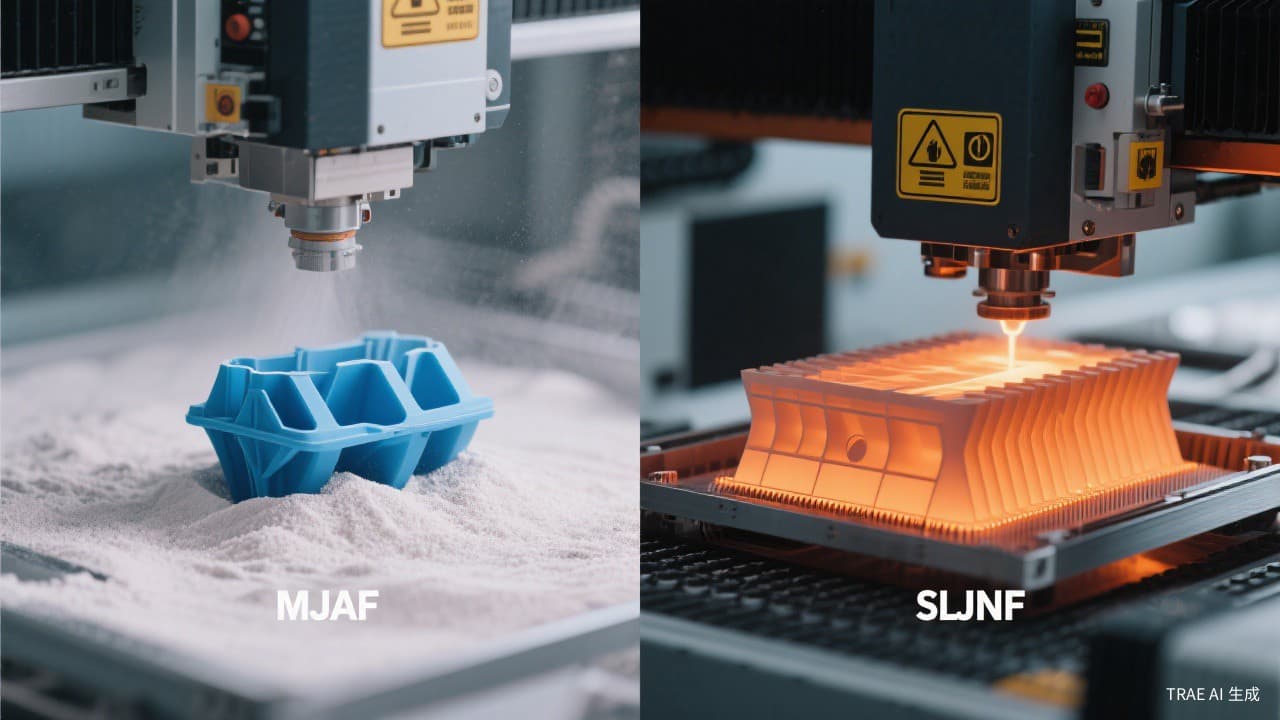
Imagine producing durable and precision parts at unprecedented speeds—or crafting complex geometries with unmatched material versatility. These are the powerhouses of Multi Jet Fusion (MJF) and Selective Laser Sintering (SLS).
Everything About the Difference Between MJF and SLS
Imagine producing durable and precision parts at unprecedented speeds—or crafting complex geometries with unmatched material versatility. These are the powerhouses of Multi Jet Fusion (MJF) and Selective Laser Sintering (SLS), the two game-changers that are reshaping how industries manufacture everything from aerospace components to medical devices.
An Introduction to MJF and SLS 3D Printing Technologies
MJF – The Assembly Line of 3D Printing
What is MJF 3D printing? Imagine an inkjet printer that can manufacture car parts. That's MJF technology in action.
The Process:
- A thin layer of nylon powder spreads across the build platform
- Print heads deposit fusing and detailing agents
- Infrared lamps sweep across, fusing the patterned areas instantly
- The cycle repeats until the project is done
Why Manufacturers Like It:
- Speed: Can print a full batch of 100+ parts quickly
- Consistency: Produces uniform parts with <0.5% dimensional variations
- Surface Quality: Achieves Ra 3.2μm right off the printer
SLS – The Swiss Army Knife of Additive Manufacturing
While MJF races ahead, SLS offers unparalleled flexibility.
Key Capabilities:
| **Feature** | **MJF** | **SLS** |
|---|---|---|
| Minimum Wall Thickness | 0.5mm | 0.3mm |
| Material Options | 4-5 | 30+ |
| Build Volume | 380×284×380mm | Up to 750×550×550mm |
| Support Structures | None needed | None needed |
Comparison Between MJF and SLS
MJF vs SLS Material Options
| **Material** | **MJF** | **SLS** |
|---|---|---|
| Standard Nylon | ✅ | ✅ |
| Flexible TPU | ❌ | ✅ |
| Glass-Filled | ⚠️ | ✅ |
| Flame-Retardant | ❌ | ✅ |
MJF vs. SLS Surface Finish
MJF offers smoother finishes (3.2μm), while SLS provides grippier textures (12μm).
MJF vs. SLS Strength
MJF parts are equally strong in all directions (48 MPa). SLS's strength works more like a well-built brick wall (45 MPa).
Print Volume
| **Technology** | **Build Volume (mm)** | **Best For** |
|---|---|---|
| MJF | 380 × 284 × 380 | High-volume small parts |
| SLS | 750 × 550 × 550 | Single large components |
Processing Time
| **Stage** | **MJF** | **SLS** |
|---|---|---|
| Printing | 8–12 hours | 24–36 hours |
| Cooling | 2–4 hours | 8–12 hours |
| Post-Processing | 1–2 hours | 4–6 hours |
| Total | 11–18 hours | 36–54 hours |
Cost Comparison
| **Number of Parts** | **Cheaper Option** | **Why?** |
|---|---|---|
| 1-20 | SLS (marginally) | Lower machine setup costs |
| 21-50 | Comparable | MJF's speed balances SLS's efficiency |
| 51+ | MJF (saves 40%) | Faster cycle times reduce labor |
Smart 3D Printing Choices for Your Business
At LC Proto, we know choosing between MJF and SLS isn't about "better" – it's about what's better for you.
For Startups – MJF is your call:
- Get functional prototypes within 48 hours
- Perfect for snap-fit electronics cases, watertight parts
For R&D Teams – SLS unlocks possibilities:
- 30+ materials from flexible TPU to flame-retardant nylons
- Create complex fluid channels, high-temp components